Brain Rules for Baby Chapter on "Smart Baby"
 John J. Medina is a developmental molecular biologist, research consultant, author of New York Times bestsellerBrain Rules: 12 Principles for Surviving and Thriving at Work, Home, and School, and a father.
This father of 2 boys believes (pg 3) that "Parents need facts, not simply advice, about raising their children…parenting is about encephalon evolution." He says that this book is "meant to let you know what scientists know – without having a Ph.D. to sympathize it."
Debunking Myths, Stating Truths
Medina happily debunks myths and confidently states the truths such as (pg 4):
Myth: Playing Mozart to your womb will improve infant's future math scores.
Truth: If yous want her to practise well in her subsequently years, the greatest thing you tin can practise is to teach the kid impulse control in her early on years.
Myth: To boost their brain ability, children need French lessons by age 3, and a room piled with 'brain-friendly' toys and a library of educational DVDs.
Truth : The greatest paediatric brain-boosting applied science…is probably a plain cardboard box, a fresh box of crayons, and two hours. The worst is probably your new flat-screen TV. Hither, Medina explains that 'open-ended play' fertilizes a kid'due south brain and is as important to his neural growth every bit protein.
22 Encephalon Rules across 5 areas
Medina divides the book into 5 topics:
1. Pregnancy
two. Relationship
iii. Smart Baby
iv. Happy Baby
5. Moral Baby
In the 'Pregnancy' affiliate, Medina discusses the 'Goldilocks Effect', a term scientists use to describe the phenomenon where too much or too little of something oftentimes proves unhelpful. He explains how maintaining a balancing deed and doing things in 'Just Right' doses will prove benign for mothers-to-be and heave babies' brain development at the same fourth dimension.
He formulates 22 notation-worthy 'Brain Rules' – things nosotros know for certain about how the early-childhood brain works (pg 260 – 275) and encapsulates these in 'Practical Tips', compiled based on the his own parenting feel and what worked for his family unit.
These help readers navigate the contents of the book and enable parents to better empathise how the researched content applies to the real globe of parenthood.
Examples in 'Happy Infant' include:
Rule #15: Emotions are just Post-it notes – telling the encephalon to pay attention to something.
Rule #xix: Labeling emotions calms big feelings – acknowledging or naming (simply not judging) emotions has a neurologically calming effect.
Seed & Soil
Medina uses an interesting 'Seed and Soil' metaphor. He asserts (pg 10), "there are some factors parents can't control and some they tin. In that location'south seed, and in that location's soil. All the nurture in the world won't modify the fact that 50 percent of your child's potential is genetic."
The professional geneticist opines nevertheless, "That said…I am convinced nosotros can exert far more than influence over our kids' behaviour than is popularly imagined. It's a very, very big job that takes a lot of work."
Both nature and nature are needed to get the desired results. He rationalises: Parenting is necessary because human babies are "brought into the earth before their brains are fully developed…a babe'southward brain simply isn't fix to survive the earth."
In 'Happy Baby: Seeds', the author, citing consistent results of research conducted over many decades, says (pg 165), "The only affair that really matters in life are your relationships to other people…Successful friendships, the messy bridges that connect friends and family, are what predict people'southward happiness every bit they hurtle through life."
In 'Happy Babe: Soil', he discusses the importance and ways of creating an environs conducive to a child's happiness. He notes (pg 213), "Parents who raise the happiest kids constantly rummage through their offspring'due south intense feelings looking for stray teachable moments. They seem to have an intuitive sense that people produce lasting alter simply in response to a crisis."
In 'Smart Baby: Seed', the writer explores the multiple ingredients that make up intelligence.
In 'Smart Baby: Soil', the author reiterates, amongst others, the importance of strong emotional regulation in improving a kid'due south academic performance.
Key points & key themes
At the finish of each chapter, Medina delivers succinct 'Key Points' which are incredibly useful summarised pointers for parents to take away.
The book consistently focuses on two fundamental themes, namely, 'empathy' and the importance of 'paying attention to a kid'south emotions'. Medina drives abode the single most-important bulletin from his volume:Be willing to enter into your kid's world on a regular basis and to empathize with what your kid is feeling. The behaviour of good parenting follows from this attitude.
Giving, but likewise getting
The concluding chapter is well worth a read. It provides heart-warming glimpses on what parenthood means to the author.
He reflects, "As you enter into your child's emotional world, your own becomes deeper. Every time I chose to put my children's priorities ahead of my own, even when I didn't experience similar it, I found I was learning to love more than honestly…In the messy work of child rearing, it's startling how greatly a two-way street the social contract actually is. You may think grown-ups create children. The reality is that children create grown-ups…Children give then much more than they take."
To him, "Kids present you with…a tantrum, simply they are really giving y'all the honor of witnessing a developing personality…You realize what a peachy privilege it is to exist a steward of another life."
Brain & Heart
As readers proceeds insight from this book written by the father-scientist, the author'southward own access and cocky-realisation may also resonate: Parenting is non all about developing human brains, information technology is virtually developing hearts.
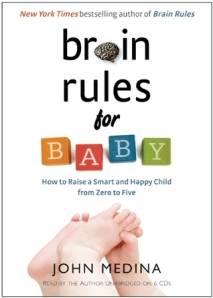
Get hold of a copy ofBrain Rules for Baby – How to Heighten a Smart and Happy Child from Zero to Fivefrom Singapore'southward Public Libraries.
Source: https://dadsforlife.sg/reads/book-review-brain-rules-for-baby-how-to-raise-a-smart-and-happy-child-from-zero-to-five-by-john-medina/
0 Response to "Brain Rules for Baby Chapter on "Smart Baby""
Postar um comentário