How to Adjust Uploaded Picture Quality in Facebook
Facebook is a great tool for sharing your images online with friends and family. Many of us do this on a regular basis, but photographers will ofttimes find their images heavily compressed. Yous've probably uploaded a photo that looked fine on your computer, but once on Facebook information technology looked soft and non as proficient!
This guide will give you all the height tips for uploading images to Facebook and retaining every bit much quality as possible. I volition encompass optimum sizes, file types and other tips for getting the virtually out of your image.
Desire to improve your social media presence? Try The Photographer's Guide to Social Media Marketing
Why does Facebook brand images lose quality?
To assist fast webpage loading times for its users, Facebook compresses all images uploaded to it. As this is done automatically, your images are subjected to a default compression, which more than likely does not suit them.
Facebook supports photos that are either 720px, 960px, or 2048px on their longest edge. Any other sizes volition have their dimensions reduced automatically, and this inevitably results in visually poorer images. Reducing the dimensions of an image decreases its sharpness, especially if it is a drastic resize.
Reducing Compression in JPEG Files
Facebook will e'er compress your images, there's no getting around that. However, there are some tricks to reducing the corporeality of compression that occurs.
The most important cistron is the dimensions of your image.Make sure you upload your photo at exactly 2048px on its longest edge. Facebook won't change the dimensions of your prototype, then there is a lot less file compression required and your photograph remains abrupt. If you aren't comfortable uploading such a large file, and so ensure that y'all upload a 960px longest border photo instead.
Once yous've resized the epitome, look to run into if information technology appears sharp enough. Make sure you are viewing the image at 100% size in your editing software. If it looks soft having been resized, acuminate it a niggling.
Then, utilize Adobe Photoshop's "Save for Web" part. Ensure that the epitome is selected to shrink to a JPEG file at lxx% quality, whilst too converting it to ansRGB color contour. More than item well-nigh using this part tin exist establish in our article "Preparing a Photo for Web Use".

Does It Actually Work?
Yes it does, and I was surprised at the degree to which it improves image quality. Here is a comparison of a photograph uploaded at two different ready of settings.
I've cropped in on the puffin that is office of a larger photo so that y'all tin can encounter the details. The sample on the left was uploaded at an obscure size of 1096px longest edge using a colour contour of Adobe RGB (1998). Y'all can see that the colours are lost slightly, particularly effectually the eye. The image loses sharpness drastically, too.
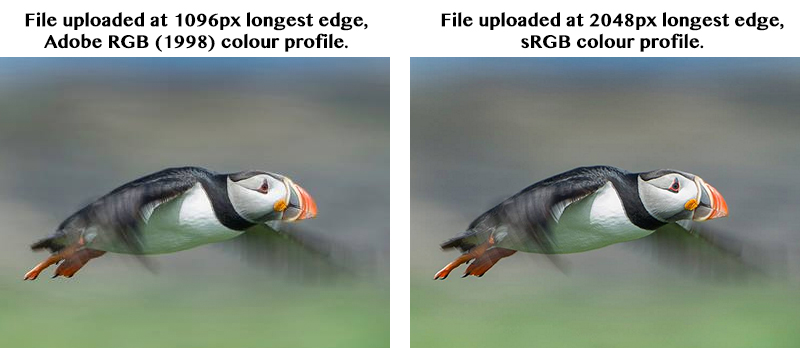
The image on the right, however, was uploaded at 2048px longest side with an sRGB color contour. I also used the salvage for web function, as mentioned above, saving at seventy% JPEG quality.
Every bit yous tin can see, the image looks a lot better for information technology. The colours are stronger, and reflect those of the original file. Yous can see crimson details around the eye and neb more than conspicuously. The clarity and sharpness of the image is besides yet at that place.
 The Benefits of Using PNG Files
What Facebook won't tell you, is that you can upload a PNG file at any size you wish and achieve a similar effect. Don't forget to catechumen information technology to sRGB as well, just you aren't restricted on your dimensions this way.
To do this, merely salvage your photograph as a PNG file using your editing software. You can also utilize the "Save for Web" function in Photoshop for this past selecting PNG-24 from the drop down list.
If you want to export PNG files straight from Lightroom, we have written a tutorial that shows you how to enable that function.
Some photographers argue that PNG produces fifty-fifty better results than JPEG. And then, try it out! Facebook doesn't mention this, strangely enough, but it is another neat way to get your images looking adept online.
Further Reading: "How to Use Facebook to Promote Your Photography"
It's Never Going to Exist Perfect
Ane thing that yous demand to go along in heed is that viewers haven't seen your original, high-resolution file. Yous, on the other manus, have.
This means that you areof course going to be comparing how your prototype looks to how the very large, full resolution original looks on your computer. Consequently, things appear to be worse than they actually are (virtually of the time).
Ensure that you are giving yourself some tolerance for the fact that you're uploading a compressed prototype in the first place. Call back nigh how yous look at other photographers' images online – they are nearly likely feeling simply like yous about online pinch.
In reality, though, you view their images thinking they wait peachy. They may argue otherwise, but on social media websites it'southward all nigh how the viewer perceives the prototype in the kickoff place.
Summary
So equally you tin can come across, images don't accept to look horribly compressed equally presently as you upload them to Facebook. Just follow the steps higher up, and you'll be wishing yous knew this before!
Here is a summary of what I've covered, in 4 quick and piece of cake steps.
- Resize your image to 2048px on its longest edge.
- Apply the "Save for Web" role, and select 70% JPEG quality.
- Brand sure the file is converted to the sRGB color profile.
- Upload it to Facebook, and brand sure you tick "loftier quality" if you are given the option (usually only for uploading albums).
Or, endeavour using PNG files, as mentioned higher up!
Remember, if you lot're uploading images online you lot may want to protect them. We've written instructions forhow to find websites that are using your photoswithout permission – brand sure to read this! It tin can throw up some very interesting results.
Don't forget to download our free PDF: The Photographer'due south Guide to Facebook.
Source: https://www.naturettl.com/upload-photos-facebook-best-quality-possible/
0 Response to "How to Adjust Uploaded Picture Quality in Facebook"
Postar um comentário